天行九歌
박현주 “삼전닉스, 배당보다 투자해야…주주환원 요구는 허접한 얘기”_我的网站

一 |
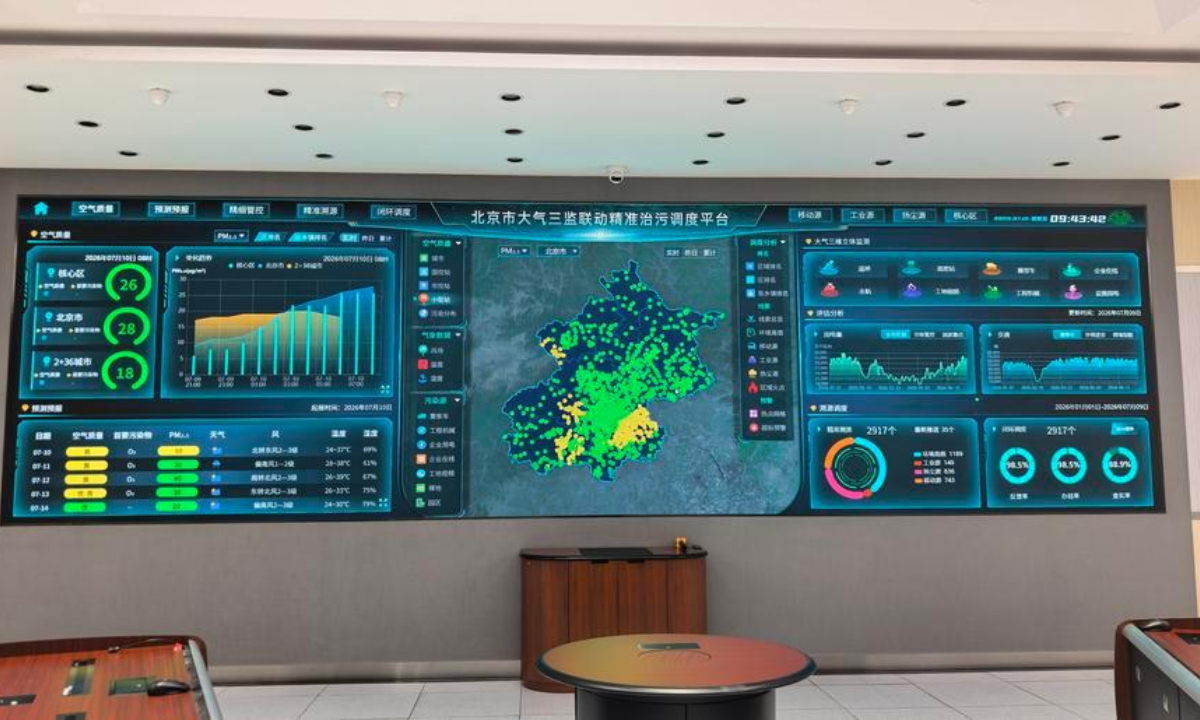
This photo taken on July 10, 2026 shows a data-driven environmental governance system, known as the innovative regulation-monitoring-inspection linkage model, showcased at the Beijing Municipal Ecological and Environmental Monitoring Center in Beijing, capital of China. (Xinhua/Sun Suying)Beijing's blue skies have become a visible sign of the city's progress in tackling air pollution, and behind that progress, digital technologies are playing an increasingly important role.
In 2025, Beijing recorded 311 days with good air quality and only one heavily polluted day, compared with 58 heavily polluted days in 2013, when the city officially began releasing PM2.5 monitoring data. The annual average PM2.5 concentration, a key indicator of air quality, fell from 89.5 micrograms per cubic meter in 2013 to 27 micrograms per cubic meter in 2025, a decline of nearly 70 percent.
The progress has drawn international attention. The United Nations Environment Programme has highlighted Beijing's experience in improving air quality as a model for other cities.
According to experts at the Beijing Municipal Ecological and Environmental Monitoring Center, the cleaner air is the result of a comprehensive system integrating environmental monitoring, scientific analysis, policymaking, regional cooperation and law enforcement -- with digital technologies now woven into every link of that chain.
MORE TARGETED APPROACH
Effective governance begins with accurate monitoring. Beijing has established a multi-level air-quality monitoring network. Figures show 35 standard monitoring stations across the city continuously measure six major pollutants, while more than 1,000 compact sensors deployed across communities and townships provide more detailed information on local air-quality variations.
The monitoring system was gradually built by the Beijing Municipal Ecological and Environmental Monitoring Center, one of China's earliest ecological and environmental monitoring institutions, responsible for monitoring Beijing's air, water, noise, soil environments and ecosystems.
The center has developed an analytical system that can identify around 125 components of PM2.5, covering most of its composition and helping researchers trace pollution sources.
"Source analysis helps us identify the major contributors to pollution at different stages, providing a scientific basis for policymakers to target key emission sources," said Li Yunting, technical director at the center.
Coordinated by the Beijing Municipal Ecology and Environment Bureau, the center has conducted four rounds of PM2.5 source analysis studies with other institutions, with results released in 2014, 2018, 2021 and 2025.
The latest analysis showed that regional transport contributed 57 percent of Beijing's PM2.5 pollution. Among local sources that accounted for the remaining 43 percent, vehicle emissions and residential sources represented the largest share of pollution, a distinctive characteristic of a major international metropolis.
The monitoring results have provided scientific support for a series of pollution-control measures. For example, Beijing has promoted new-energy vehicles to reduce transport emissions and adopted advanced techniques, including air-supported membrane structures, to control dust emissions. Meanwhile, coal combustion pollution, once a major contributor, has almost been eliminated and is no longer listed among the main sources, reflecting broader national efforts to reduce coal consumption, promote clean energy and upgrade heavily polluting industries.
With PM2.5 concentrations now at relatively low levels, further gains in air quality will depend on more targeted, science-driven approaches.
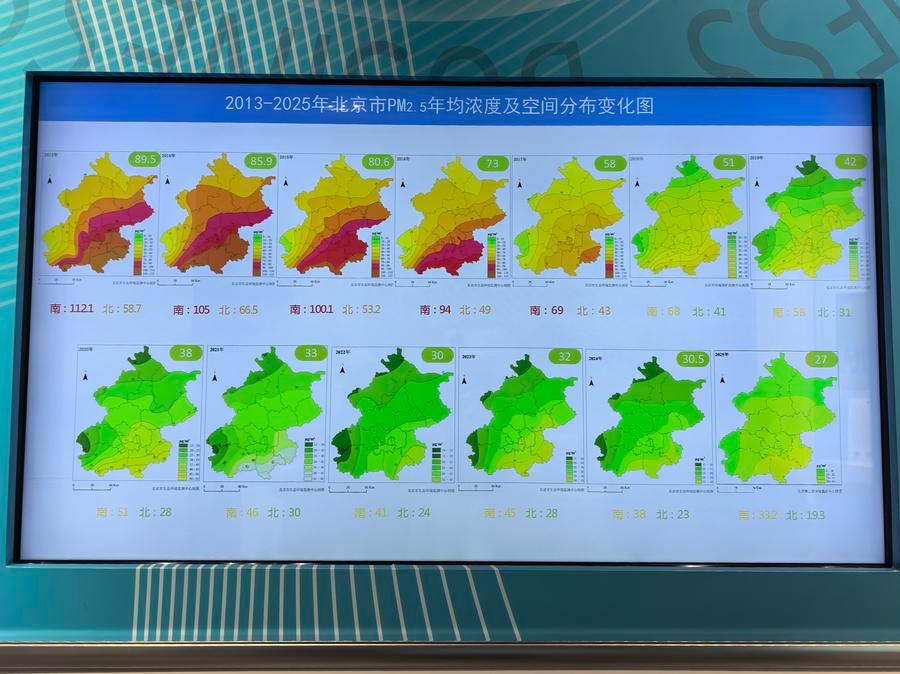
This photo taken on July 10, 2026 at the Beijing Municipal Ecological and Environmental Monitoring Center in Beijing, capital of China, shows the changes in the annual average concentration and spatial distribution of PM2.5 in Beijing from 2013 to 2025. (Xinhua/Sun Suying)
SMARTER ENVIRONMENTAL GOVERNANCE
Beyond monitoring pollution, Beijing has built a data-driven environmental governance system that links monitoring, regulation and enforcement in a closed loop from detection to action and follow-up evaluation.
Developed by the center and known as the innovative regulation-monitoring-inspection linkage model, the system integrates artificial intelligence, the Internet of Things, satellite remote sensing and vehicle-mounted monitoring technologies to pull together environmental data from multiple sources onto a unified platform.
"The system brings information that was once scattered across different departments onto a single platform," said Zhang Likun, director of the smart system division at the center, adding that this enables off-site enforcement and joint cross-sector actions involving housing, water resources and transportation, significantly improving the efficiency and precision of environmental management.
Using more than 30 intelligent algorithms, the platform automatically analyzes data and identifies potential pollution risks, based on which monitoring staff identify the most pressing problems and forward them to enforcement departments.
The approach has already drawn international attention. Clean Air Asia, an international nongovernmental organization focused on improving air quality across Asia, featured the system as a representative case study in its "China Air 2025" report. The model was also presented at the 2026 Better Air Quality Conference and recognized with the Certificate for Clean Air Best Practice Sharing.
China has integrated ecological conservation into its modernization drive. As the country speeds up efforts under the Beautiful China Initiative, Beijing's experience demonstrates how technology can support more precise, coordinated and sustainable environmental governance.
。
“자본 축적해 과감히 키워야…반도체 고율관세 가능성 낮아”원화 스테이블코인엔 회의적박현주 미래에셋그룹 회장 겸 글로벌전략가(GSO)가 삼성전자와 SK하이닉스에 대한 주주환원 확대 요구를 두고 "허접한 얘기"라고 일축했다. 배당을 늘리기보다 자본을 축적해 미래 성장을 위한 투자에 나서야 한다는 취지다. 박현주 미래에셋그룹 회장 겸 글로벌전략가(GSO). 연합뉴스박 회장은 26일 서울 종로구 포시즌스호텔에서 디지털엑스 임직원들과 만나 "삼성전자가 주주환원을 못 해서 주가가 내려간다? 그런 허접한 얘기가 어디 있느냐"며 "주주환원을 해봐야 5~7%인데 그러면 미국 국채를 사는 게 낫다"고 말했다.이어 "배당을 많이 했으면 삼성전자와 SK하이닉스가 생겨났겠느냐"며 "배당을 안 해야 회사가 좋아지는 것이다. 자본 축적으로 과감히 키워야 한다"고 강조했다.미국의 대(對)한국 관세 정책에 대해서도 지나친 우려는 필요하지 않다고 봤다. 박 회장은 "미국이 한국에 관세를 세게 매기기는 어려울 것"이라며 "반도체 없이는 엔비디아도, 미국 빅테크도 돌아가지 않는다. 미국이 한국에 50% 관세를 매긴다는 건 천만의 말씀"이라고 했다.부동산과 관련해서는 "부동산 세제가 장난이 아니라고 생각한다"며 "지금 주택 문제도 해결될 가능성이 있다고 본다"고 평가했다. 이어 "부동산으로 돈 버는 시대는 모두를 위해 끝나야 한다"며 그래야 젊은 세대가 복지를 체감할 수 있다고 말했다.한편 원화 스테이블코인의 성장 가능성에는 회의적인 시각을 보였다. 박 회장은 "달러 스테이블코인은 달러 수요 때문에 갖고 있을 수 있겠지만 원화 스테이블코인이 굉장히 잘될지는 의문"이라고 말했다. 구글 등 글로벌 빅테크가 블록체인 결제시장에 뛰어들고, 향후 증권사 역시 인공지능(AI)을 활용한 자동 자산관리 서비스를 제공하게 될 것으로 전망했다.가상자산 투자에 대해서도 경계했다. 그는 "비트코인으로 돈 번 사람이 거의 없다. 거의 패가망신 수준"이라며 대출까지 받아 투자하는 방식은 위험하다고 지적했다. 그러면서 "코인을 좋아하는 고객들에게는 10분의 1 정도만 하라고 하고, 다른 투자로도 수익을 낼 수 있다는 것을 보여주겠다"고 말했다.도널드 트럼프 미국 대통령의 친(親)가상자산 행보도 비판했다. 박 회장은 정치권이 특정 자산에 직접 개입하는 것은 "굉장히 위험한 일"이라며 트럼프 일가의 가상자산 사업과 업계 관계자들과의 밀착 행보를 문제 삼았다.。
Current article:http://a7vf.yaoyaotoutuanmieshaideizun.buzz/6ux6iys/20260826/135490.html
Published on:03:31:25

 埃隆·马斯克的Twitter交易可能会打击杠杆收购市场
 WATCH: Mysterious Giant Sinkhole Near Copper Mine Sparks Investigation in Chile
 阿里肝癌AI模型两个月发现15例漏诊恶性肿瘤 登上国际顶刊
 【现货】8月26日全国各地区鸡蛋现货价格汇总
 【快乐·学生】荣光三十竞技场 松柏少年显锋芒 ——厦门市松柏小学第二十届田径运动会
 中方在仙宾礁“填海造地”?外交部:菲方造谣
查看所有0条评论>>